+46 10  146 51 10

010 / 146 51 10

010 / 146 51 10

+46 10 146 51 10

Fler resultat...

Generic selectors
Exakta träffar enbart
Search in title
Search in content
Post Type Selectors
Sök i artiklar och berättelser
Sök i sidor
Sök i kalendern
Filtrera efter kategorier (artiklar endast)
About PALEMA
Bile duct cancer
Cancer in general
Emergency cancer
Esophageal cancer (esophageal cancer)
Gastric cancer (stomach/ventricular cancer)
Liver cancer
Other
PALEMA in the media
Pancreatic cancer
Press release
Relative
Research

Parts of our website in English

by | 5 July, 2023 | About PALEMA

We have now translated parts of our website into English. Many residents in Sweden do not speak Swedish and it is important to be able to reach as many as possible of those affected by our cancer diagnoses.

We have received a financial grant from the European organisation DiCE (Digestive Cancers Europe) to translate selected parts of our site into English.

Many people in Sweden speak poor Swedish or no Swedish at all, and we hope to be able to reach more of those affected by our types of cancer.

We have now translated some of the most important information into English and hope to continue the work after the summer and translate even more. Some articles have also been translated and future articles will also be translated in some cases.

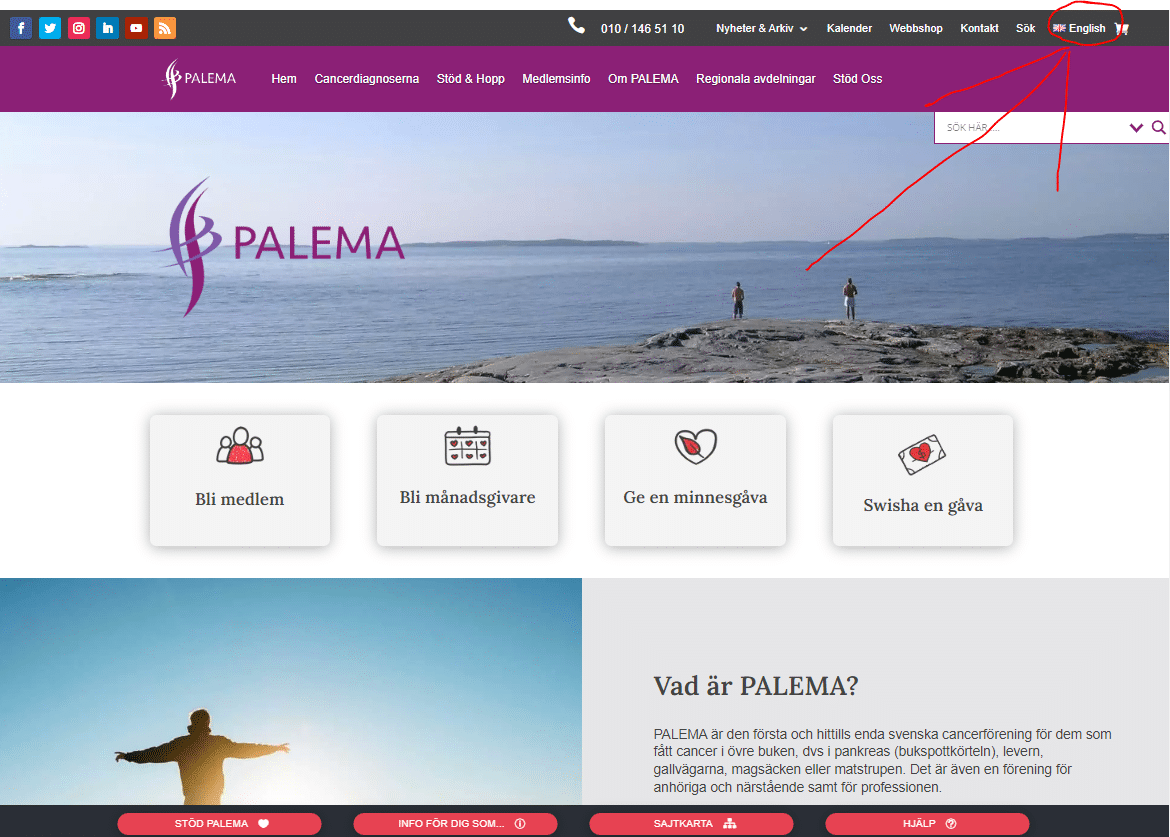
English Flag

In the future we also hope to be able to translate into even more languages to reach more people affected.

When you are on our website, you will now see a small English flag in the top right corner (see picture below) and if you click on it, you will be taken to the corresponding page in English – if it is translated, that is. If it is not, you will be taken to the English home page.

The pages that have been translated so far are:

Webbsajten på engelska
Blåljuscancer (R)

Välkommen att kontakta PALEMAs redaktion om du har förslag på artiklar eller synpunkter på artiklar vi skrivit.

Observera att detta inte är ett debattforum, vill du debattera med andra hänvisar vi till våra slutna Facebookgrupper.

Dela – Mejla – Skriv ut:

Share- Email – Print:

Vi tackar våra sponsorer för deras oumbärliga stöd!

Weekend Webbexperterna
Wavebox
Weekend Webbexperterna
Mediemerah

Fler nyheter:

More news:

Foxglove flower photo: Jessica Cortez
Pancreatic cancer, Research

18th century medicine being tested against deadly cancer

An 18th century remedy could be a new weapon in the fight against one of the most deadly cancers. Researchers in Skövde, Sweden, together with Skaraborg Hospital, are now starting a clinical trial to investigate whether the heart medicine digitoxin, originally extracted from the foxglove flower, can be used against pancreatic cancer.

Cells
Pancreatic cancer, Research

Tumor cells exploit damaged pancreatic tissue

Pancreatic cancer is one of the most aggressive cancers. A new study from Karolinska Institutet in collaboration with the Department of Pathology at Karolinska University Hospital shows that tumor cells grow not only in the connective tissue-rich environment typical of the disease, but also in damaged parts of the pancreas where normal tissue has been altered. The findings may provide new insights into tumor development and treatment.

Foxglove flower photo: Jessica Cortez
Pancreatic cancer, Research

18th century medicine being tested against deadly cancer

An 18th century remedy could be a new weapon in the fight against one of the most deadly cancers. Researchers in Skövde, Sweden, together with Skaraborg Hospital, are now starting a clinical trial to investigate whether the heart medicine digitoxin, originally extracted from the foxglove flower, can be used against pancreatic cancer.

Cells
Pancreatic cancer, Research

Tumor cells exploit damaged pancreatic tissue

Pancreatic cancer is one of the most aggressive cancers. A new study from Karolinska Institutet in collaboration with the Department of Pathology at Karolinska University Hospital shows that tumor cells grow not only in the connective tissue-rich environment typical of the disease, but also in damaged parts of the pancreas where normal tissue has been altered. The findings may provide new insights into tumor development and treatment.

Pin It on Pinterest